ABOUT IMMA
A community shaped by scientific exchange.
Promoting and encouraging the science and technology of mesostructured materials.
The International Mesostructured Materials Association connects researchers who design, synthesize, characterize, and apply porous and mesostructured materials. We bring together a global community exploring how controlled internal architecture creates new materials functionality.
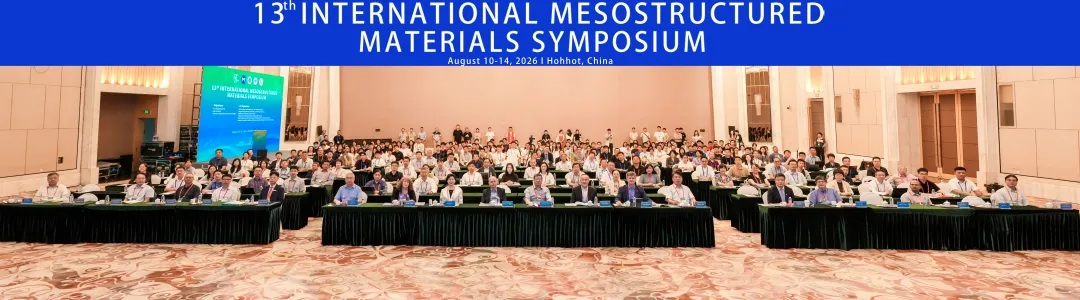
Different approaches. A shared interest in internal architecture.
Our community spans polymer and surfactant templating, colloidal assembly, direct crystallization, selective etching, and other routes to controlled porosity.
We welcome researchers working across porous-materials science, from catalysis to energy harvesting and storage, and from selective capture and separations to the control of optical, electronic, and magnetic behavior.
What unites this community is the use of controlled porosity to tune transport, accessible surface area, and other key materials properties—turning the apparent “nothing” of void space into a powerful tool for functional materials design.
Scientific exchange
Meetings that connect discoveries, disciplines, and researchers.
A community across the years
1998
The first ISMMS brought the community together in Baltimore.
2000
The International Advisory Board established IMMA at the second ISMMS in Québec City.
2026 · Our community’s reach
1,200+
conference participations
400+
research talks
750+
poster presentations
Documented minimums across available symposium records, 1998–2026. Repeat participation is counted; historical records are incomplete.
Our origins
The 1992 report of periodic surfactant templated mesoporous materials (1) helped stimulate an extensive international research effort. The concept that homogeneous, ordered porosity did not need to be coupled to the long range periodicity of a crystalline lattice, as in a zeolite, created a renaissance for porous materials research. Researchers expanded the pores sizes, the synthesis methodologies, the material systems, and the applications. As the field developed, researchers sought a forum for sharing discoveries and building connections.
Reference (1)
(1) Kresge, C. T.; Leonowicz, M. E.; Roth, W. J.; Vartuli, J. C.; Beck, J. S. “Ordered mesoporous molecular sieves synthesized by a liquid-crystal template mechanism.” Nature 359, 710–712 (1992).